|
|
 |
 |
|
|
 |
 |
 |
 |
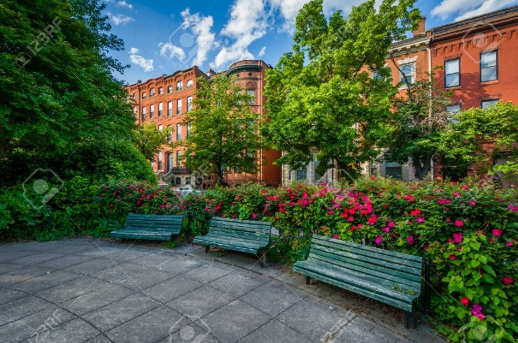
Bolton Hill is an historic district listed on the National Register of Historic Places. It is an urban neighborhood of tranquil, tree-lined streets lined with an outstanding collection of restored mid to late 19th century townhouses, urban mansions, churches, and public buildings. Bolton Hill is peppered with quaint urban parks, historic fountains, and grand monuments that complement the period architecture. There are also several award-winning modern town home enclaves tucked away amidst the historic homes. Most homes contain plots of exterior space set out as hidden retreats or formal gardens that combine with the elegant buildings to make Bolton Hill an urban retreat in the city. In addition to the physical structure, Bolton Hill has a fascinating mix of residents of all age groups, races, religions, ethnic backgrounds, and lifestyles, making it one of the most diverse and accepting neighborhoods in Baltimore.

|
 |
 |
 |
 |
Bolton Hill borders the city's cultural district, which features The Lyric Theater, Meyerhoff Symphony Hall, Walters Art Museum, and Everyman Theater. Neighborhood residents can listen to the symphony, go to an opera, and watch live theater without ever moving their cars. The renovated Charles Theater, featuring first-run movies and art house films, is also only a short walk away. Penn Station, with Amtrak and MARC commuter service, is a ten-minute walk. The Cultural District, Mt. Royal, and North Ave. light rail stations and the State Center subway stop serve the neighborhood. Two local bistros, b. and On the Hill, provide the neighborhood with eclectic menus, and some of Baltimore's best restaurants are only a short distance away.
The Mapleleaf, Fitzgerald, Sumpter, Lion, and John Street parks and the Park Avenue and Eutaw Place medians provide a chance to meet neighbors, linger, and enjoy being part of Bolton Hill. The Bolton Swim and Tennis club is the center of summer activities for many residents and children in Bolton Hill with an Olympic-size pool, a youth swim team, tennis courts, tennis pro, a playground, and a picnic area.
Artscape, the nation’s largest free public arts festival, is a staple of summer life in Baltimore. It brings national and local artists to the neighborhood in a three-day festival and celebration featuring a full spectrum of visual and performing arts, an artist’s market, an international menu of food, and great live concerts.
Every October, Bolton Hill’s own Festival on the Hill brings visitors and residents together to celebrate with food, crafts, music, and art. The Bolton Hill Band Concert is an annual, summertime attraction in Fitzgerald Park featuring the Baltimore City Band with spirited music, good food, and camaraderie.
|
 |
 |
 |
 |
Most Bolton Hill residences were constructed between 1850 and 1900, and more than 85% of them remain as single-family, owner-occupied homes. With the ongoing conversions of many of the neighborhood’s rental properties back to single family homes, this percentage continues to grow. The remainder of the homes consists of a mix of rental apartments, single-family rentals, and condominiums. The historic housing stock is largely intact, with most residences lovingly cared for and restored. A rich variety of street-front facades set these homes apart. Stone sills outlining oversized windows and the liberal use of brownstone facades and massive graystone at the base suggest very grand interiors. Wrought iron fencing, decorative window grilles and gateways, and patches of lawn – rare for 19th century row houses – define the homes as exceptional. Most houses exhibit massive marble or brownstone steps and a liberal use of marble on the exterior. The Beethoven Apartments, in the 1500 block of Park Avenue, were erected in the 19th century as Baltimore’s first street-front terrace, or group of houses constructed to appear as a single structure. The three and four-story graystone Friends Apartment at Park and Laurens was built by a Friends Congregation as a meetinghouse sometime before 1896. Friends School took over that space in 1899. The property was converted to apartments in 1974 and then to condominiums in 2007.
|
 |
 |
 |
 |
|
 |
|
Click here
for more information on this Neighborhood's History. |
 |
 |
 |
 |
| This list may not include all schooling options for this neighborhood. For more information on Baltimore schools visit the Live Baltimore's School Links. |
- Bolton Hill Nursey (preschool)
- Midtown Academy (K-8)
- Mt Royal (K-8)
- Maryland Institute College of Art
- Baltimore Bible College
- University of Baltimore (not in Bolton Hill, but within walking distance)
|
|
 |
|
|
| |
Average Home Sales— Prices by neighborhood
Baltimore I-Map — City mapping tool for cultural, civic, and property information
Baltimore Citistat— City agency accountability tool
Crime Mapping— Search recent crime data by address through the Baltimore Police Dept.
Baltimore Neighborhood Indicators Alliance— Track a variety of data through their interactive mapping system
| |
Druid Heights CDC
2140 McCullloh Street
Baltimore, MD 21217
410-523-1350
www.druidheights.com
People’s Homesteading Group, Inc.
410 East North Avenue
Baltimore, Maryland 21202
410-889-0071
St. Ambrose Housing Aid
321 E. 25th Street
Baltimore, MD 21218
410-235-5770
www.stambros.org
Search over 20 Incentive Programs that may be available to you
Find a lender, insurance company, title company & more - search our City Living Partners
Search our Preferred Real Estate Professionals by neighborhood specialty
Find homes for sale & rent in our Classified Ads
| |
|
|
|
|
|